
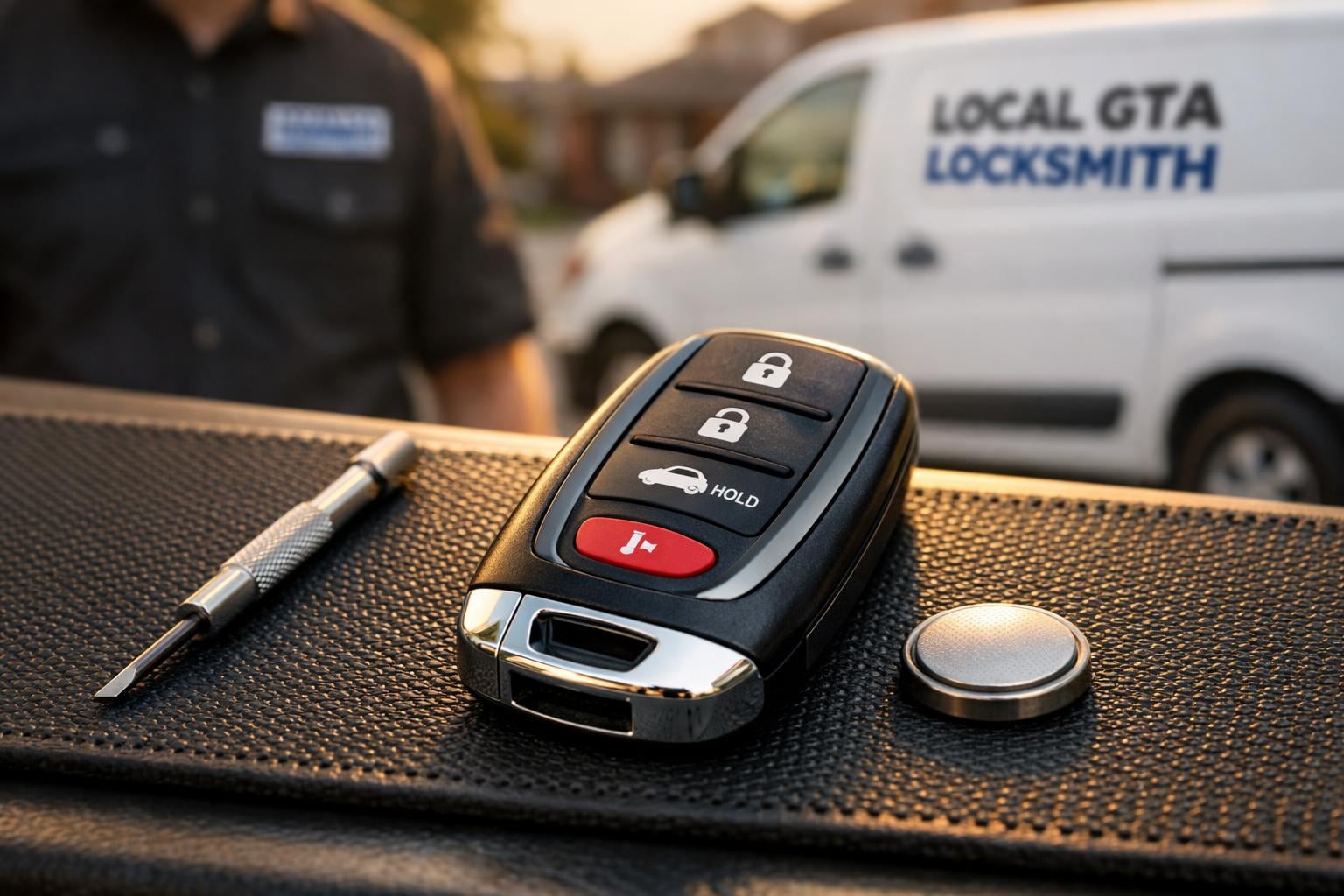
Toyota Key Fob Replacement | GTA
Toyota-specific key fob replacement guidance for cracked shells, dead buttons, unreliable smart fobs, or full replacement decisions.
Best next step
Use this page when the fob is damaged, unreliable, or partly working and you want to decide between battery, repair, replacement, or smart-key follow-up.
Make-specific
Platform context matters
Workflow
OEM and system differences
Next-step routes
Service and security branches
What this guide covers
Toyota-specific key fob replacement guidance for cracked shells, dead buttons, unreliable smart fobs, or full replacement decisions.
Get a quote by phone
Tell us your vehicle year, make, model, and what happened. We quote over the phone - no obligation until you say go.
Call Now: (647) 557-8103What Toyota fob users usually need to know
Key-fob replacement pages work best when they help the user decide whether the real issue is battery, housing, board failure, or smart-key replacement.
Not every failing fob needs the same solution
This page is designed to separate shell damage, battery decline, and deeper smart-fob replacement situations.
Toyota smart-access context
The useful brand-specific angle is how transponder, remote-head, and proximity workflows common on commuter-focused Japanese platforms changes what replacement and testing should include.
Daily-use reliability matters
These are high-volume GTA daily drivers where owners usually care about same-day recovery, dependable spares, and avoiding unnecessary dealer downtime. That makes partial fob failure especially disruptive even before it becomes a total no-start or no-entry problem.
When replacement is usually the better path
A credible page should not claim every fob can be repaired forever.
Repeated button or shell failure
If the housing and controls are degrading together, replacement may be more dependable than another temporary fix.
Smart-key detection issues
When proximity or push-start behaviour becomes inconsistent, the user often needs more than a cosmetic repair.
Compatibility and testing still matter
Jobs often need a practical balance between cost, reliability, and how quickly the vehicle must be back in service. Even on a replacement page, the value is in explaining how the fob will actually be verified with the vehicle.
Best related routes from here
These related routes are usually the most useful next step once the key condition and the real problem are clearer.
Step-by-step
- 1
Battery replacement
Relevant when symptoms point to a power issue rather than a full replacement need.
- 2
Smart-key programming
Important when the replacement fob also needs pairing and function validation.
- 3
Push-to-start key security
Useful for owners whose concern has expanded from convenience to key-control and anti-theft awareness.
Why this matters
- Toyota context for models like the Camry, Corolla, and RAV4.
- transponder, remote-head, and proximity workflows common on commuter-focused Japanese platforms
- Jobs often need a practical balance between cost, reliability, and how quickly the vehicle must be back in service.
Questions that usually change the next step
These details usually decide whether the fastest route is direct service, compatibility troubleshooting, repair, or security follow-up.
Fob replacement pages should not ignore condition versus pairing
Users often need help distinguishing battery, housing, board, and full replacement decisions before the service path is obvious.
Smart-key overlap should be explicit
On some platforms the page is more useful when it clearly bridges into smart-key and security context rather than acting like a simple remote-shell swap.
Replacement intent should stay practical
The most useful next step is the one that improves reliability, convenience, and confidence in the key, not just the fastest way to get another fob shell.
What usually matters on this make
These make-specific details often influence the key type, the workflow, and what the safest next step looks like.
Key detail 1
Toyota context for models like the Camry, Corolla, and RAV4.
Key detail 2
transponder, remote-head, and proximity workflows common on commuter-focused Japanese platforms
Key detail 3
Jobs often need a practical balance between cost, reliability, and how quickly the vehicle must be back in service.
Choose the best route from here
Brand-specific pages work best when they help users decide whether to continue researching the make, move into the direct service path, or compare a related intent cluster.
Toyota Brand Hub
Return to the Toyota overview page for broader make-specific research.
- Toyota context for models like the Camry, Corolla, and RAV4.
- Use this route when you want a more specific next step than a generic service overview.
Key Fob Replacement
Use the main service page when you want the direct operational route without the brand-specific context layer.
- transponder, remote-head, and proximity workflows common on commuter-focused Japanese platforms
- Use this route when you want a more specific next step than a generic service overview.
Broken Key Fob or Failing Buttons?
Read the diagnosis-first page for this symptom before or after reviewing the direct service.
- Jobs often need a practical balance between cost, reliability, and how quickly the vehicle must be back in service.
- Use this route when you want a more specific next step than a generic service overview.
Brand and service routes
Use these links to move into the direct service page, a closer diagnosis route, or the wider brand hub if you still need broader research.
Toyota Brand Hub
Return to the Toyota overview page for broader make-specific research.
Compare Toyota Brand HubKey Fob Replacement
Use the main service page when you want the direct operational route without the brand-specific context layer.
Go to Key Fob ReplacementBroken Key Fob or Failing Buttons?
Read the diagnosis-first page for this symptom before or after reviewing the direct service.
Read Broken Key Fob or Failing Buttons?Push-to-Start and Smart-Key Security
Useful for users who also need the security or anti-theft context around this service.
Review Push-to-Start and Smart-Key SecurityCommon questions
These answers focus on the brand-specific details that usually matter before booking the job.
Can a damaged Toyota key fob always be repaired instead of replaced?
Not always. Some fobs are better candidates for shell or battery work, while others are more dependable to replace once board or smart-access issues appear.
Why use a Toyota-specific key fob page?
Because users with models like the Camry, Corolla, and RAV4 often want to understand how the platform changes smart-fob expectations, replacement fit, and testing depth.
Should I also review smart-key security if the fob is failing?
If the vehicle relies on a single smart key or the key has been exposed, that security branch can be a useful follow-up.
Ready to move forward?
Need Toyota fob replacement guidance?
Use the direct replacement page when the fob is clearly the problem, or branch into battery, smart-key, and security pages when the diagnosis is still evolving.